

Your Saturday morning starts with a pull cord that won’t catch, a gas can you forgot to refill, and a lawn that’s already looking shaggy. For decades, that ritual defined suburban lawn care. Today, though, battery-powered mowers, trimmers, and blowers have become genuinely competitive alternatives, and the choice between cordless and gas equipment is no longer obvious. Cordless tools win on convenience, noise, and maintenance; gas still holds an edge for very large properties and heavy-duty, all-day jobs. If you want a real-world example of what modern battery equipment looks like in practice, check out this review of a mid-size cordless mower. Below, we break down the trade-offs so you can pick the right setup for your yard.
Quick Answer
For most homeowners with lots under about half an acre, cordless electric equipment is the better everyday choice: less maintenance, no fumes, quieter operation, and instant starting. Gas equipment still makes sense if you mow several acres, need to run tools continuously for hours, or already own gas tools and want to keep one fuel system. Battery voltage, amp-hour capacity, and spare batteries matter more than brand hype when sizing cordless gear to your property.
Key Takeaways
- Match the platform to your yard size: battery tools handle most suburban lots, while gas remains practical for large acreage or all-day use.
- Cordless equipment cuts maintenance to almost nothing (no oil changes, spark plugs, or carburetor issues) but requires battery management.
- Total cost differs by scenario: gas has a lower upfront price but higher ongoing fuel and service costs, while cordless costs more initially and less over time on batteries.
- Noise, emissions, and storage convenience strongly favor cordless for residential neighborhoods.
- Pick one battery platform and stick with it, since batteries are often the most expensive part of the system.
How Cordless and Gas Equipment Actually Differ
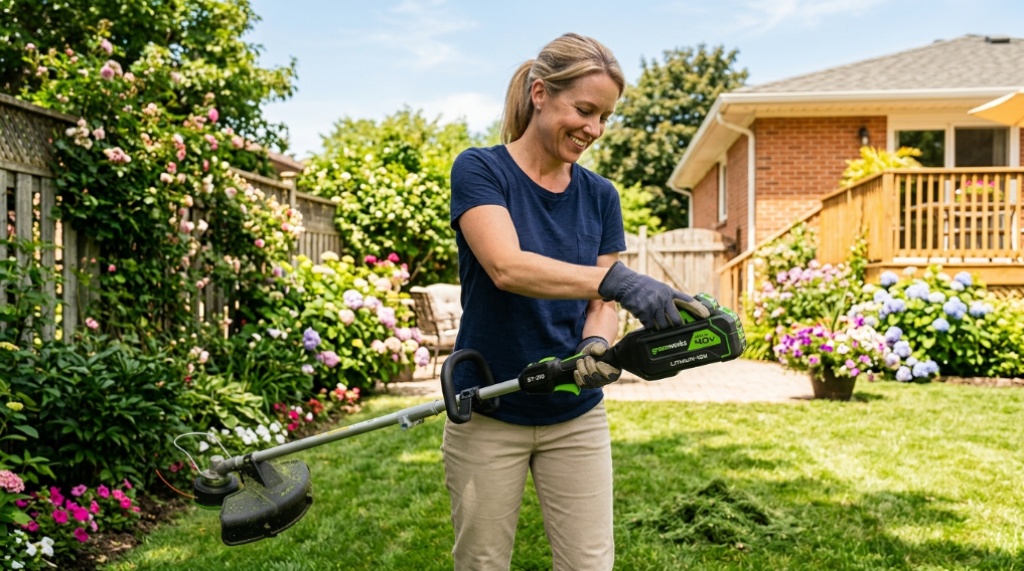
Both types of equipment cut grass and clear debris. The real differences show up in how they start, how they’re maintained, how long they run, and how they feel to use week after week.
Gas engines deliver power through combustion and typically run on a mix of gasoline and oil (two-stroke) or straight gasoline (four-stroke). They produce significant torque, which is useful for thick grass and heavy trimming. They also require fuel storage, oil changes (on four-stroke models), air filter cleaning, spark plug replacement, and seasonal preparation to avoid stale fuel problems.
Cordless tools run on rechargeable lithium-ion batteries. They start with a button press, produce no exhaust, and need almost no routine service beyond cleaning and blade sharpening. Their runtime depends on battery capacity, blade load, and grass conditions. High-voltage platforms (typically 40V to 80V) deliver performance that comes close to smaller gas engines for most residential tasks.
Runtimes, Yard Size, and Battery Reality
The biggest practical question is whether a battery will finish your yard before it dies. That depends on three things: your lawn’s square footage, the thickness and dampness of the grass, and the amp-hour rating of the battery you’re using.
As a rough guide, a standard residential battery on a mid-size cordless mower can typically handle a typical suburban front-and-back yard on a single charge, while larger or thicker lawns often require a second battery or a recharge break. Trimmers and blowers draw less power and usually run considerably longer per charge than mowers.
Two habits make cordless systems far less frustrating:
- Buy a second battery. Rotating two packs doubles your effective runtime and lets one charge while you work.
- Mow when grass is dry. Wet, overgrown grass drains batteries dramatically faster than a routine trim on dry turf.
Gas equipment, by contrast, runs as long as you have fuel. That’s its clearest advantage, and it’s the one that matters most if your property is large, If you are also planning your landscaping climate needs, check out our guide on what is the best grass for florida lawn to keep your yard thriving year-round.
Maintenance, Noise, and Neighborhood Practicalities
Cordless equipment wins decisively on maintenance. There’s no oil to change, no spark plug to foul, no carburetor to clean after a winter of stale fuel, and no pull cord to wrestle with. You charge the battery, install it, and go. Seasonal storage is simpler too: you don’t have to drain a fuel system or add stabilizer.
Noise and emissions are the other major factors. Gas mowers and trimmers are loud enough to require hearing protection and often generate complaints in dense neighborhoods with early-morning noise ordinances. Battery tools are dramatically quieter, which matters if you mow early, live close to neighbors, or simply don’t want the noise yourself.
There’s also the question of exhaust. Gas equipment produces fumes and emissions at the point of use. For homeowners with young children, pets, or respiratory sensitivities, battery tools remove that concern entirely. In some regions, local rules or rebate programs actively encourage switching to electric equipment for exactly this reason.
Cordless vs. Gas: A Side-by-Side Comparison
| Factor | Cordless Electric | Gas |
|---|---|---|
| Starting | Push-button, reliable | Pull cord, can be finicky |
| Maintenance | Minimal | Regular (oil, plugs, filters, fuel) |
| Runtime | Limited per battery | Unlimited with fuel supply |
| Noise | Quiet | Loud |
| Emissions | None at point of use | Exhaust and fumes |
| Upfront cost | Usually higher | Usually lower |
| Long-term cost | Lower, but batteries need replacement | Fuel and service add up |
| Best for | Typical suburban lots | Large properties, heavy continuous work |
Cost: What You Pay Now vs. Over Time
Upfront, gas equipment is usually cheaper. A basic gas mower often costs less than a comparable cordless model, and the same pattern holds for trimmers and blowers.
Over time, the math shifts. Gas equipment needs fuel, oil, spark plugs, air filters, and occasional professional service. Fuel stabilizer, ethanol-related carburetor problems, and tune-ups can add up quickly. Cordless equipment needs almost no service, but batteries eventually lose capacity and must be replaced, which is a real cost that should be factored in.
If you already own several gas tools, staying on that platform avoids doubling your fuel and maintenance setup. If you’re starting fresh or replacing aging equipment, cordless often wins on total cost of ownership for typical suburban use, especially when you consider the time saved on maintenance.
Which Should You Choose?
The decision usually comes down to property size and how you use the tools.
- Small to medium yard (under about half an acre): Cordless is the practical choice. Quieter, cleaner, easier to store, and no fuel hassles.
- Large yard or acreage (one acre or more): Gas, or a high-voltage cordless platform with multiple large batteries, may be necessary. For very large properties, gas remains hard to beat.
- Mixed needs: Many homeowners run a cordless mower and trimmer for routine work while keeping one gas tool, often a blower or chainsaw, for heavy jobs.
- Noise-sensitive or HOA-regulated neighborhoods: Cordless has a clear advantage due to quieter operation and cleaner emissions.
- Cold climates: Gas starts can be rough in cold weather; battery performance also drops in cold temperatures, so plan for both.
Common Mistakes to Avoid
- Buying a cordless tool without checking battery voltage and amp-hour rating against your actual yard size.
- Mixing battery platforms across brands, which forces you to buy multiple chargers and prevents battery sharing.
- Letting gas sit in equipment over winter without stabilizer or draining, which is a leading cause of spring startup failure.
- Assuming all cordless tools perform equally. Voltage, build quality, and blade design vary widely.
- Ignoring battery replacement costs when comparing long-term value.
Frequently Asked Questions
Is cordless lawn equipment powerful enough for thick grass?
Yes, for most residential lawns. High-voltage cordless mowers handle routine and moderately thick grass well. Very tall, wet, or dense grass may require slower passes or a second battery, and gas still holds an edge in the heaviest conditions.
How long do cordless lawn tool batteries last?
Most lithium-ion batteries retain useful capacity for several years of regular seasonal use before noticeably degrading. Actual lifespan depends on charge habits, storage temperature, and how often the battery is fully drained.
Can I use one battery across a mower, trimmer, and blower?
Yes, if all tools belong to the same battery platform. Staying within one brand’s ecosystem is one of the simplest ways to get more value from your batteries and chargers.
Is gas lawn equipment being phased out?
Some states and municipalities have introduced restrictions or incentives targeting small gas engines, particularly in California. Rules vary widely, so check local regulations if this affects your decision.
Do cordless tools work in cold weather?
They work, but battery runtime drops in cold temperatures. Storing batteries indoors and letting them warm up before use helps. Gas tools also have cold-start challenges, so neither option is immune to winter issues.
What’s the most important spec when buying cordless equipment?
Battery voltage and amp-hour rating, along with the platform’s overall tool ecosystem. These determine runtime, performance, and how easily you can expand your setup later.
Conclusion
For most homeowners, cordless equipment is now the smarter default: easier to start, cheaper to maintain, quieter, and cleaner, with performance that handles typical suburban yards without trouble. Gas still earns its place on large properties or where continuous, heavy-duty runtime is essential. The most reliable approach is to match the platform to your actual yard size, commit to a single battery ecosystem, and factor battery replacement into your long-term costs. Choose based on how you mow, not on brand marketing.